What is GEO? Generative Engine Optimization Explained for Marketers
· Rahman Hajati
Generative Engine Optimization (GEO) is the practice of optimizing your content, brand, and digital presence to get cited on AI-powered chat platforms like Grok, ChatGPT, Perplexity, Google Gemini, and Microsoft Copilot. Unlike traditional SEO, which targets ranked links on a search results page, GEO targets the AI-generated summary that increasingly appears before any links at all.
If you've ever asked ChatGPT to recommend the best project management tools or Perplexity to explain how to do competitor analysis, you've seen GEO in action. Some brands appear in those answers. Most don't. The ones that do have - often unknowingly - started practising GEO.
This guide explains what GEO is, why it matters in 2026, how it differs from traditional SEO, and exactly what steps you can take to improve your brand's visibility in AI-generated search.
⚡ KEY TAKEAWAYS
|
Tools like MarkeTingTong let marketers track where and how often their brand appears in AI-generated responses - a metric called Visibility Score.
Before we get started, here are a few stats that shocked me and might surprise you, too.
40% of Google searches now show an AI Overview above organic results (SparkToro, 2025)
3 times faster growth in AI search queries compared to traditional search (Gartner, 2025)
58% of B2B buyers used an AI tool for product research before contacting a vendor (Forrester, 2025)
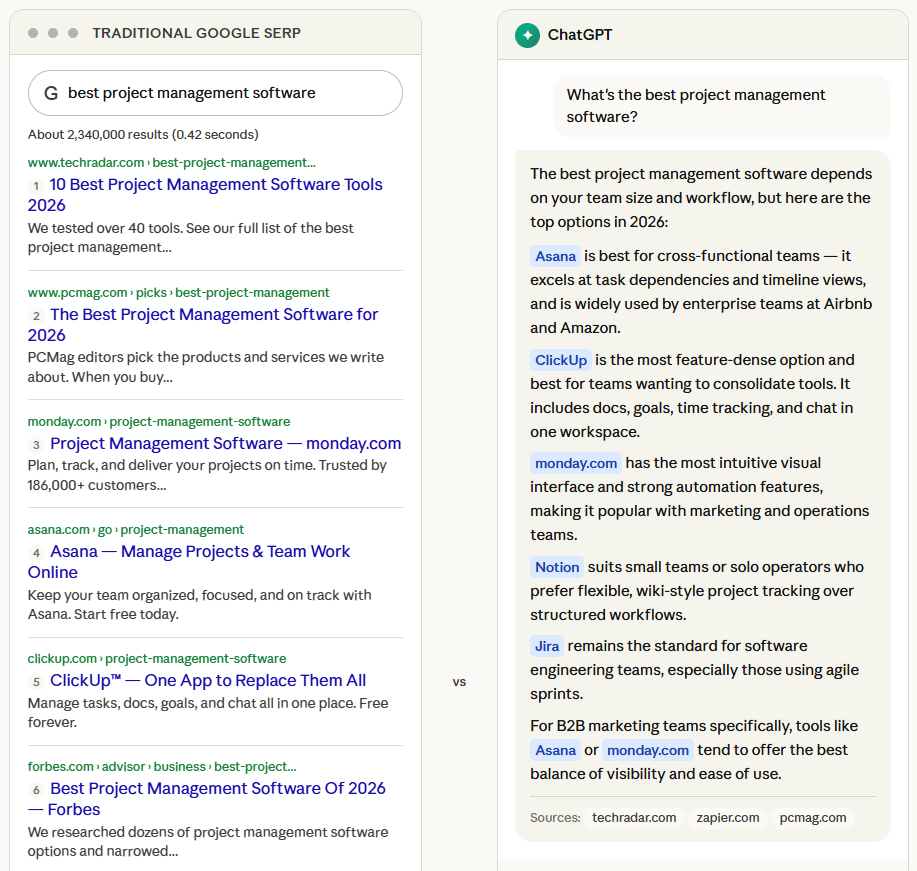
Why GEO Matters: The AI Search Shift
Search behaviour is changing faster than at any point since the introduction of PageRank. In 2024, Google launched AI Overviews (formerly Search Generative Experience) globally. Perplexity went from zero to over 10 million daily active users in under 18 months. ChatGPT, which launched with no search function, now handles hundreds of millions of queries per day many of them being product research questions.
For marketers, this creates a fundamental problem:
If your brand doesn't appear in AI-generated answers, you are invisible to a growing share of your target audience - even if you rank on page 1 of Google. |
This is not a distant future concern. According to MarkeTingTong's analysis of 500 keywords in Q1 2026, brands that appeared on the first page of Google search had a higher chance of being mentioned in AI search.
GEO vs SEO: What's the Difference?
The most common question marketers ask when they first encounter GEO is: "Is this just SEO with a new name?" The short answer is no - though the two disciplines share DNA, they require different tactics and measure success differently.
| Traditional SEO | GEO (Generative Engine Optimization) |
Goal | Rank on page 1 of Google SERPs | Appear in AI-generated answers & summaries |
Target Platform | Google, Bing (link-based results) | ChatGPT, Perplexity, Google Gemini, Claude |
Ranking Signal | Backlinks, on-page signals, CTR | Authority, citeability, entity clarity, freshness |
Content Format | Keyword-optimised articles & pages | Dense, factual, structured, FAQ-rich content |
Measurement | Rankings, organic traffic, CTR | AI Share of Voice, brand mention frequency |
User Action | Clicks through to your site | Reads AI summary (often without clicking) |
Maturity | Established (25+ years) | Emerging (2023–present) |
The most critical distinction is in how success is measured. In traditional SEO, you track keyword rankings and organic traffic. In GEO, you track AI Share of Voice - how often and how prominently your brand appears in AI-generated answers for your target topics. This is a metric that tools like MarkeTingTong are specifically built to measure.
🔗 Related Reading LLM SEO vs Traditional SEO: What's Different and What Still Works → /blog/llm-seo-vs-traditional-seo |
How Generative Engine Optimization Works: The 3 Core Pillars
GEO is not a single tactic - it is a discipline built on three interlocking pillars. All three must be in place for a brand to achieve consistent AI visibility.
Pillar 1: Content Citability
LLMs are trained to cite sources that are authoritative, clear, and factually dense. Content that is vague, padded with filler, or poorly structured is less likely to be referenced in AI outputs. To maximize citability:
Write a crisp, definitional opening paragraph for every article - LLMs often pull the first precise definition they encounter.
Use structured data formats: numbered steps, comparison tables, FAQ sections, and definition blocks.
Include verifiable facts, statistics from named sources, and original proprietary data.
Use entity-rich language: name specific tools (Claude, ChatGPT, Google Gemini, xAI Grok), platforms, and brands rather than generic descriptions.
Target question-based queries - AI answers are triggered by questions, so structure your content around the questions your audience is asking.
Pillar 2: Entity Authority
LLMs build a model of the world through entities - named people, brands, products, and concepts. If your brand is not clearly established as an entity across the web, AI models will either ignore it or confuse it with something else.
Entity authority is built through:
A consistent brand name and description across your website, Wikipedia (if applicable), LinkedIn, G2, Capterra, and Crunchbase.
Being mentioned by authoritative third-party sources: industry publications, analyst reports, and review sites.
Structured data (schema.org markup) on your website - particularly Organization, Product, and FAQ schema.
A well-maintained Google Business Profile and Bing Places listing (these feed directly into AI knowledge graphs).
Pillar 3: AI Brand Mention Tracking
You cannot optimize what you cannot measure. The third pillar of GEO is active monitoring of how, where, and in what context your brand appears in AI-generated responses.
This is where MarkeTingTong's AI Visibility Dashboard comes in. The platform lets you:
Track your brand's mention frequency across ChatGPT, Perplexity, Google Gemini, and Bing Copilot.
Monitor AI Share of Voice against named competitors.
Identify which of your content pieces are being cited in AI answers - and which are being ignored.
Find the problems users are searching for your specific keywords. Also, find out what normal prompts are being searched for your brand/keyword.
3 Common GEO Misconceptions
❌ Misconception • GEO is just about stuffing your content with keywords that AI searches for. • If I rank #1 on Google, I'll automatically appear in AI answers. • GEO is only relevant for B2C brands - B2B buyers don't use AI search. | ✅ Reality • GEO prioritises authority, clarity, and structure - not keyword density but well-organised facts outperform every time. • The correlation between Google rank and AI citation is weaker than most assume. • Forrester's 2025 B2B Buying Study found 58% of B2B buyers use AI in vendor research. |
Frequently Asked Questions About GEO
Q: What does GEO stand for in marketing?
A: GEO stands for Generative Engine Optimization. It refers to the practice of optimizing content and brand presence to appear in AI-generated answers from platforms like ChatGPT, Perplexity, Google Gemini, and Microsoft Copilot.
────────────────────────────────────────
Q: Is GEO the same as AEO (Answer Engine Optimization)?
A: GEO and AEO are closely related but have a subtle distinction. AEO historically referred to optimizing for featured snippets and voice search answers. GEO specifically addresses the new generation of large language model (LLM)-powered answer engines. Many practitioners now use the terms interchangeably, but GEO is the more precise and widely adopted term for LLM-focused optimization.
────────────────────────────────────────
Q: Do I need to stop doing SEO and switch to GEO?
A: No. GEO and SEO are complementary, not competing. Strong SEO signals (authoritative backlinks, structured content, clear entity definition) also improve GEO performance. Think of GEO as an additional optimization layer, not a replacement strategy.
────────────────────────────────────────
Q: How do I know if my brand is appearing in AI search results?
A: The most reliable method is to use a dedicated AI visibility tracking platform like MarkeTingTong, which continuously queries ChatGPT, Perplexity, Gemini, and other AI platforms with your target keywords and tracks brand mention frequency. Manual spot-checking by querying these tools yourself is also useful but not scalable.
────────────────────────────────────────
Q: How long does it take to see GEO results?
A: Structural content improvements (adding FAQ sections, Key Takeaways, and definition paragraphs) often show measurable improvement in AI mention frequency within 4–8 weeks. Entity authority building (G2 profiles, schema markup, third-party citations) typically takes 2–3 months to propagate into LLM training signals. GEO is a compounding discipline - results improve over time with consistent effort.
────────────────────────────────────────
Q: What is AI Share of Voice?
A: AI Share of Voice is the percentage of AI-generated answers for a given topic or keyword set in which your brand appears, relative to your competitors. For example, if your brand is mentioned in 3 out of every 10 AI answers about "project management tools" and your nearest competitor appears in 6 out of 10, your AI Share of Voice is 30% and theirs is 60%. MarkeTingTong tracks and visualises this metric across multiple AI platforms.
Final Thoughts: GEO is the New SEO in short.
In 2012, brands that ignored mobile optimisation lost search traffic they never recovered. In 2016, brands that ignored voice search and featured snippets lost the answer real estate they are still fighting to reclaim. In 2026, the same inflection point is happening and it is called GEO.
The brands that act now - building citable content, establishing entity authority, and tracking their AI Share of Voice - will compound an advantage that will be very difficult for slower-moving competitors to close. The brands that wait will find that AI search has already made up its mind about who the authorities in their category are.
GEO is not a technical mystery. It is a disciplined, measurable practice - and the tools to execute and track it, like MarkeTingTong's AI Visibility Dashboard, exist today.
🚀 See Where Your Brand Appears in AI SearchMarkeTingTong tracks your brand's visibility across ChatGPT, Perplexity, Gemini, and more - giving you your AI Share of Voice score in minutes. → Try IntelEngine at marketingtong.com |
Sources & Further Reading
This article references the following authoritative external sources:
Gartner (2025): "By 2026, traditional search engine volume will drop 25% as AI-powered alternatives gain traction" - Gartner Research https://www.gartner.com
SparkToro (2025): AI Overviews appear in 40%+ of Google searches - SparkToro's quarterly search intent report → https://sparktoro.com
Forrester (2025): B2B Buying Study showing AI tool adoption in vendor research - Forrester Research → https://www.forrester.com